The One Thing for Extraordinary Results

“The ONE THING” is about taking the shortest path to achieving extraordinary results. It is not just about getting stuff done and being more productive: It’s about having meaningful days; being motivated and happy; working on important things that make a difference and that have a real impact.

Finding the Shortest Path to a Big Goal
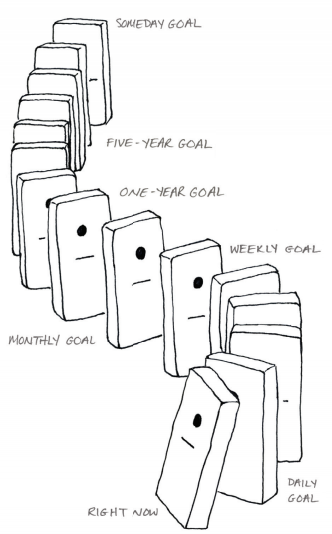
The lead domino

1. Identify your long term goal

This process is about achieving a long term goal as quickly as possible. But you need to have a goal in mind.

2. Identify your one year goal

Ask yourself: “What is the ONE THING I can do THIS YEAR such that by doing it everything else will be easier or unnecessary in achieving my long term goal?” That ONE THING is your goal for the year.

3. Identify your goal for THIS MONTH

“What is the ONE THING I can do THIS MONTH such that by doing it everything else will be easier or unnecessary in achieving my one year goal?” That ONE THING is your goal for the month.

4. Identify your goal for THIS WEEK

“What is the ONE THING I can do THIS WEEK such that by doing it everything else will be easier or unnecessary in achieving my one month goal?” That ONE THING is your goal for the week.

5. Identify your goal for this TODAY

“What is the ONE THING I can do TODAY such that by doing it everything else will be easier or unnecessary in achieving my one week goal?” That ONE THING is your goal for today.

6. Work on TODAY’s goal for the first 4 hours of your day

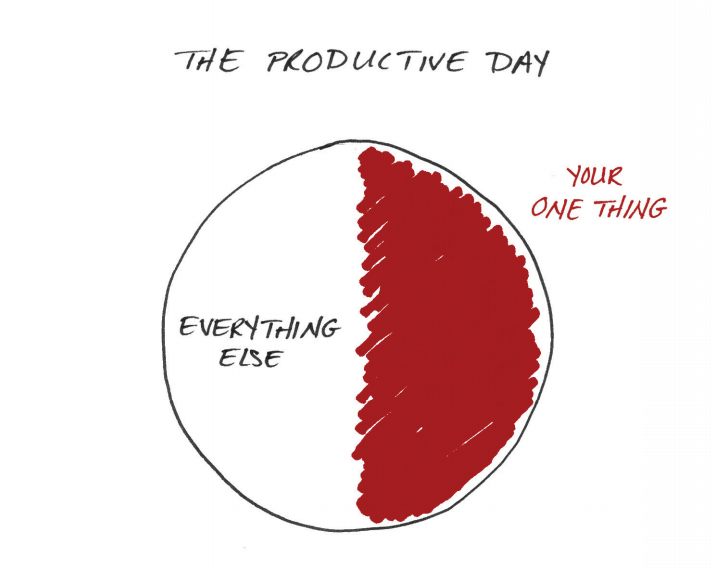
Spend the FIRST HALF of your day working on your ONE THING. No interruptions, no distractions, no emails, no phone calls, no meetings. Just laser focused work on your most important task. Your morning is spent on your most important thing. The afternoon is left for emails, phone calls, and meetings. By working on your ONE THING first, you are sure it will get done. Things left for later have a chance of not getting done.

Meaningful Days

This process is not just about getting stuff done and being more productive: It’s about having meaningful days; being motivated and happy; working on important things that have a real impact and that truly make a difference.

Since I’ve started to use this process I’m more engaged at work, more motivated, less stressed out, and happier. I get to devote uninterrupted time to important meaningful projects that will have a huge impact. If I “run out of time” during my day, it’s the unimportant things that get dropped.

The Productive vs The Unproductive Day

Do you ever feel like you’ve been SUPER busy all day, yet didn’t get anything accomplished? Those are the days where you DID NOT work on your one most important thing.

The difference between a PRODUCTIVE day and an UNPRODUCTIVE day is how much time you spend on your ONE THING. If you work on your ONE THING first, your day is already productive and rewarding by the time lunch rolls around. It doesn’t matter what happens the rest of your day.

The Myth of Multitasking

It is a myth that you get more done by doing many things at the same time. If you want huge success, you need to be very narrowly focused. If you try to do two things at once you won’t do either well. Chasing too many rabbits leads to catching none.

“Do fewer things for more effect
instead of doing more things with side effects”

Multitasking is a form of self distraction. When switching between two tasks, there is always a reorientation phase, and that’s wasted time.

tot_interruptions

The 80 / 20 rule

Not all things matter equally. Not all tasks are created equal. You need to focus on those that matter most and that produce the biggest results: If 20% of you activities result in 80% of your results, then you should be spending more of your time on those activities.

tot_8020

The Importance of Only ONE Thing

There can only be one most important thing. Many things may be important, but only one can be the most important. Not a few things… Not two things… ONE THING!

What is my ONE THING?

If today you (or your company) don’t know what your ONE THING is, then your ONE THING is to figure that out.

Family, Friends, and Life Outside of Work

Following this process means spending a large amount of time focused on a single often “work” related goal. That usually means less time for your family, friends, and other priorities. It is very important to ensure you are spending quality time with your family and friends during your evenings, weekends, and vacations.

“Imagine life is a game in which you are juggling five balls. The balls are called  work, family, health, friends and integrity. And you’re keeping all of these in the air. But one day you finally come to understand that work is a rubber ball. If you drop it, it will bounce back. The other four balls – family, health, friends and integrity – are made of glass. If you drop one of these, it will be irrevocably scuffed, nicked, perhaps even shattered.”

Chaos!

Following this process tends to cause some chaos. Since you have less time to do “maintenance” work, you will tend to experience a messy desk, a messy email inbox, etc… Either clean it up in the afternoon, or live with it. Those are the costs of narrow focus and great results.

“It’s not that we have too little time to do the things we need to do, it’s that we feel we need to do too many things in the time we have.”

Other Applications…

In your non-work life

The “One Thing process” can also be used at a smaller scale in your non-work life: What is the ONE thing you can do for your family that will have the most positive effect? What is the ONE thing you could do for your spouse that would make your relationship better? What is the ONE thing you could do for your parents or friends? What is the ONE thing you could change to improve your health? What is the ONE thing from a personal standpoint that would bring you the most happiness? Etc…

In your company

Your company should use this process to be laser focused on it’s most important, most impactful goal. And at a smaller scale, each department and each employee should have their long term goals with work backs to what their ONE THING for today is. If you have weekly status meetings, they should be used to help identify everyone’s ONE THING. Employee performance reviews should be about their ONE THING. Etc…

More About this Topic

If you like the One Thing as I’ve described it here, and want to learn more about it, then I highly recommend you purchase the book or visit the Official One Thing site

Why Businesses should help ex-employees find their next job

When an employee leaves, proactively help them find their next job. The faster they find a new job the less likely they are to get into a desperate situation and to do something that is against your best interest.

Firing someone sucks. Every situation is different, stressful, and unpleasant. For many small businesses, a decision to lay someone off often comes after weeks or months of deliberation, and after looking at all possible alternatives.

Even if you give a good severance package and a letter of reference, it’s sometimes not enough. I believe that a business’ responsibility to the employee isn’t done until they find their next job or career. When an employee leaves, the business should proactively help the ex-employee find their next job.

Here are some specific business reasons why it might be a good idea to go above and beyond to help an ex-employee land on their feet:

  • Build goodwill for future opportunities: Your past employees will have a more positive attitude towards you and your business if they feel that you genuinely did your best to help them. They are less likely to hold a grudge and more likely to help you in the future when an opportunity presents itself.
  • Strengthen relationships with current employees: Current employees will look to how you treat your past employees as an indication of how they will be treated when they leave.
  • Reduced risk of harm to the business: The faster a past employee finds a new job, the less likely they are to get into a desperate financial situation, and the less likely they are to do something for financial gain that is against your best interest, or that violates an NDA or non-compete.

If you are a business owner and are laying someone off, consider going the extra mile to help that employee find their next job — I think it will have long term benefits for your business.

Polyphasic Sleep for Jetlag

Most recommendations for recovering from Jet-lag involve avoiding sleep at your destination until night time. Here is an alternative: Polyphasic sleep to pro-actively catchup on the sleep you are about to miss.

The Plan

  1. Follow traditional best practices for avoiding Jet Lag.
  2. 20 minute naps every 4 hours: As soon as you land go on a dynamic “everyman” sleep schedule (20 minute nap every 4 hours) until night time and then either
    1. Sleep as long as you can (if you can); or
    2. if you cannot sleep, take another 20 minute nap and try sleeping again in another 4 hours.
  3. Repeat on the second day: When you wake up, record the time and plan on another 20 minute nap in 4 hours (and continue the cycle).
  4. Stop the nap schedule once you feel you are onto the local rhythm, but I recommend to stick with it for at least 2 days.
  5. Start on the plane: If you are on a really long flight with multiple connections, you can try starting your nap schedule early by napping at airports during connections or on the plane before you land.

Important: You are not trying to reduce sleep. You are trying to catch up on sleep you have already missed and future sleep you are about to miss. So don’t purposely stay up all night — if it’s night time and you can get an entire night’s sleep in, then go for it. But if it’s day time then be strict with your nap schedule.

Tips

  • Take wind down time into account. It usually takes me 15-20 minutes to fall asleep, so I usually schedule my nap 15 minutes earlier and set my alarm for 35 minutes.
  • It is ok if you don’t actually sleep. Lying in a comfy spot with your eyes closed for 20 minutes will refresh you enough to help push you through another 4 hours of awake.
  • Plan your day around your sleep schedule to make sure you can get your naps in
  • Carry ear plugs and a night mask (and an inflatable pillow?) to maximize your “anywhere / anytime” nap opportunities.
  • Use the website JetLagRooster.com to prep your sleep schedule even before you leave and get tips on how to adapt once you land (note: They do not have naps built into their schedule)

Related Posts

How to Make Your Children Smarter: Entity VS Incremental Learning

Children tend to view their intelligence in one of two ways: “I am smart at this” where they believe they have a fixed level of intelligence. And “I tried hard at this” where they believe their level of intelligence is flexible and influenced by hard work.

Entity Learners: “I am smart at this”

“Entity” learners believe in a fixed level of intelligence: I.e.: “I am good at math; I am bad at english”.

They believe they have a fixed level of ability and there is very little they can do to change their results.  Since success or failure implies “smart” or “not-smart”, they will tend to avoid risk of failure.

Incremental Learners:
“I tried hard at this”

“Incremental” learners believe their level of intelligence is flexible and influenced by hard work. “I got it because I worked very hard at it” or “I should have tried harder”.

The learning is more important than the results. When faced with failure, they increase their efforts or change their tactics. Step by step they can move from novice to master.

Winning and Losing

Winning is still very important. But learning is more important than winning or losing.

“It would be easy to read about the studies on entity vs incremental theories of intelligence and come to the conclusion that a child should never win or lose. I don’t believe this is the case. If that child discovers any ambition to pursue excellence in a given field later in life, he or she may lack the toughness to handle inevitable obstacles. While a fixation on results is certainly unhealthy, short term goals can be useful development tools if they are balanced within a nurturing long-term philosophy. Too much sheltering from results can be stunting.”

Josh Waitzkin, The Art of Learning

Assume your child is playing high-school level soccer. Which is better? Winning against a kindergarden team or losing a close match against a university team? I would argue that playing against the stronger team (win or lose) will have much better long term benefits than winning against the kindergarden team. If you never lose then you are not challenging yourself enough.

If your child experiences a crushing defeat, don’t patronize them by saying that “it doesn’t matter if you win or lose”. Your child is feeling strong emotions that clearly matter to him. Your words will not resonate with his reality.  Instead acknowledge those feelings and focus on the learning: “I know you put a lot of effort into this and you wanted to win very badly. Not winning hurts a lot sometimes, but it can also help you get better.  Let’s learn from this — let’s train harder and get better for the next match. The best way to get better is to face strong opponents, and when you face strong opponents you will lose sometimes. But you will get better. And the better you get, the more you will win.”

“I have seen many people in diverse fields take some version of the (incremental learning) philosophy and transform it into an excuse for never putting themselves on the line or pretending not to care about results. They claim to be egoless, to care only about learning, but really this is an excuse to avoid confronting themselves.”

Josh Waitzkin, The Art of Learning

What Parents or Teachers can do

The language used by parents or teachers play a big role in a child’s view of their intelligence.

Language such as “You are really good at math, but bad at English” will tend to reinforce that intelligence is a fixed and unchangeable. Children will learn that they are good at math and bad at English. They will link their success and failure  to a predefined fixed level of ability. There is nothing they can do about it, so they will not try to get better.

Focus on the learning. Re-enforce that they can change their results with effort: “You are really doing good in math: Keep up the good work! You are struggling in english: Let’s study a little harder!”.

It is never too late

“It is clear that parents and teachers have an enormous responsibility in forming theories of intelligence of their students and children — and it is never too late. It is critical to realize that we can always evolve in our approaches to learning. Studies have shown that in just minutes, kids can be conditioned into having a healthy learning theory for a given situation.”

Josh Waitzkin, The Art of Learning

Resources

Balance Your Life by Planning your Week

What is “Balance”

I don’t like the term “Work/Life” balance because it implies that there are only two areas of importance: Work and Life. The reality for most of us is that “Life” is actually composed of several important roles: Parenting, Homeownership, Friendships, Community, “Me” time, etc….

Most of us already spend at least half our waking hours at work. This does not leave much time for the other important areas in your life.

How I Plan My Week

Every weekend I go through the following ritual to plan the coming week.

1. Review your Personal Mission Statement

Although not absolutely necessary to begin, a personal mission statement gives you guidance and is a reminder of what is important to you.  If you don’t already have one, take some time to write one. Every week review your mission statement and update it as necessary.

My Personal Mission Statement:

To find happiness, fulfillment, and value in living I will strive to:

  • Make a positive difference in the lives of others;
  • Spend more quality time with friends and family;
  • Simplify my life; work less; have more “perfect days”; and keep an open mind;
  • Do great things; strive for excellence; and inspire others.
  • Apologize sincerely when necessary.
  • Remember that life is short; be grateful; relax and enjoy the moment; Memento Mori.

2. Identify & Review your Roles

Achieving “balance in life” isn’t about getting a 50/50 balance between “work” and “life”.  You play many more than just 2 roles in life. You should devote time to all the roles you play: Individual, Father, Husband, Friend, Employee, Homeowner, Artist, World Traveler, Adventurer, etc…

Identify all the roles you play in your life that you would like to devote more time to. Ideally you should have somewhere between 4 -8 roles identified. Each week you should make an effort to spend a little bit of time in each role.

My Roles:

  • Individual
  • Father / Husband
  • Family Member (son, brother, cousin)
  • Friend
  • Employee / Entrepreneur
  • Homeowner

Every week I review this list of roles to ensure that they are current.

Personal Renewal

In addition to the roles above, there are 4 special “personal renewal” roles that you should devote time to each week:

  • Physical: Eat healthy, exercise, etc…
  • Mental: Read, learn, etc…
  • Social: Strengthen existing relationships, form new relationships, networking, etc…
  • Spiritual: Meditate, nature, music, religion, etc…

3. Identify and Review your long term Goals

For each of your roles (except the personal renewal roles) your should define some long term goals. What are some big picture goals that would make a tremendous difference if you accomplish them? Make them as specific as possible and not too vague. Each week you should spend a little bit of time getting closer to your goals.

I review my goals weekly to make sure they are still important to me and that they align with my personal mission statement.

Some of my Goals :

  • Individual: Resume Painting; Climb Mt. Kilamanjaro; Visit the Pyramids of Giza.
  • Father / Husband: Weekly date night; 10 year anniversary trip; Build swing set;
  • Family: Help my father lose 50lbs; Family cottage trip; 
  • Friend: Help my friends identify and achieve their goals;
  • Homeowner: Renovate garage; Build a pool; 

4. Identify your Priorities and Plan your Week

One I’ve reviewed my mission statement, roles, and goals I’m ready to start identifying my priorities for the week and scheduling them into my calendar. For each of my roles I choose between 1 and 3 important priorities/tasks to work on that week.

Here is the process I go through to identify my priorities for the week:

  • Leftovers from the previous week: I always look back at my previous week to see if there is anything that I wanted to get done that I didn’t get done. I then decide if I want to bring these over for the current week or not.
  • Previously scheduled commitments: I look over my coming week to identify any previously scheduled commitments, holidays, events, etc… and add them to the appropriate role.
  • Maintenance and unforeseen important tasks: There are usually some “unplanned” things that pop up every week that should be added to my list of priorities: Things like paying bills, making required repairs to your home/car, etc..
  • Your Goals: Finally I look at the goals I defined for each role and make it a priority to do something that will get me a step closer towards achieving those goals.

In an ideal world all your weekly priorities would be centered around your goals, but often times there will be other important or urgent things that will compete for your time. Please read my post “The Four Quadrants of Time Management” to better understand the difference between “important” and “urgent” things.

Example of my weekly priorities:

  • Physical: Gym x2; Run x3; Nutrition
  • Mental: Learn a new Language; Read a book
  • Spiritual: Go for a solo Hike; Play Guitar; Meditate;
  • Social:  Go out for lunch with co-workers
  • Individual: Research VISA requirements for travel to Kenya; Research recommended training regiment for Mt. Kilimanjaro climb; Research estimated costs for trip;
  • Father / Husband: Buy flowers for wife; Spend 1-on-1 time with daughter; Start budget/savings plan for 10 year anniversary trip;
  • Family: Visit my father weekly (and call daily) to make sure he is following his Slow Carb Diet.
  • Friend: Go for drinks with friends;
  • Homeowner: Look at municipal pool regulations; Fall cleanup / maintenance

5. Schedule your Priorities

Using a calendar, task list, or other time management tool, schedule all of your activities into your calendar. I prefer to use the iOS calendar on my iPhone to schedule the time to perform all my priorities for the week. So if one of my priorities is to plan a family trip to Europe, then I will block off 1 hour in my schedule to perform the planning & research. It is ok if I don’t get all the planning done in the 1 hour block, what is most important is that I am chipping away towards achieving my goal. The next week, I’ll schedule another 1 hour block.

You can also use a task list or other time management tool, but I find putting all your priorities into a calendar helps you see how your realistic your week will actually be. It will also allow you to see where there will be time crunches or conflicts, etc…

Remember, the point is to get balance in your life, and to spend a little bit of time in all the “roles” you’ve defined.

Related Posts

Reactive vs Proactive Language

Most of us tend to use REACTIVE language in our day to day lives: “I CAN’T do that because I MUST do this”. Changing to PROACTIVE language can have a profound effect on your life: “I DON’T WANT to do that because I WANT to do this”.

I NEED vs I WANT
I MUST vs I PREFER
I CAN’T vs I CHOOSE

Reactive Language

Most of us tend to use reactive language in our day to day lives: “I CAN’T do this because I MUST do that”. The reality of the situation is that you probably don’t have to do the second thing and probably CAN do the first thing.

Outside of being bound by the laws of physics, there are very few things in life that you HAVE to do or that you CAN’T do. So why do we use those words?

Using reactive language absolves you of responsibility but also makes you powerless: “I am not responsible. I am not able to choose my response. There is nothing I can do about it”.

WHAT YOU SAYWHAT YOU MEAN
I can’t do that.
I just don’t  have the time
Something external (limited time) is controlling me
If only my boss were more patientSomeone else’s behaviour is limiting my effectiveness
I have to do itCircumstances or other people are
forcing me to do what I do. I am not free to choose my own actions.
Examples of reactive language.

Proactive Language

Reactive LanguageProactive Language
I need…I want…
I must…I prefer…
I can’t…I choose…

This subtle change in language can make a huge positive impact in your life.

Examples

REACTIVE
“I wish I could take 6 months off and travel the world but I can’t because I have to work and I don’t have enough vacation.”

PROACTIVE #1
“Although I would love to take 6 months off and travel, my financial security and my career are currently more important to me. I choose not to go on this trip so that I can focus on my career instead.”

PROACTIVE #2
“The experience of travelling is much more important to me than my job or my financial security. So I will convince my boss to give me a 6 month sabbatical (or just quit?) and I will go on this iconic journey.”

Re-evaluate your Paradigm

Saying that “I DON’T WANT TO go on a wonderful 6 month trip because I WANT TO work” is difficult and counterintuitive.  By changing your language you will re-evaluate your reality:

  • Do I really want to keep working instead of travelling?
  • How important is seeing the world to me?
  • How important is my job or career?
  • Is this job really what I want to do?
  • What is truly important to me?

There are no right or wrong answers to any of these questions. But asking these questions is important and empowers you to change.

Be Precise in your Speech

How you talk reinforces what you believe to be true. By being reactive with your language, you reinforce that you are powerless. By being precise and truthful with your language, you accept responsibility for your choices and gain the power to change those choices and to change your situation.

Take Responsibility.
Make it your Fault.

Until you can honestly say that “I am what I am today because of the choices I made yesterday” you cannot say “I choose otherwise”.

Never blame others for failures.  Always blame yourself. The moment you blame another person or some external circumstance, you become powerless to change the results:

THEIR FAULT
“The project failed because we didn’t get enough support from the marketing department. They need to do a better job next time.”

YOUR FAULT
“The project failed because I did not mobilize the marketing department effectively. Next time I will change my strategy and make a more effective presentation explaining the importance of their role in the success of this project.”

The more responsibility you take, the more power you have to change.

Related Reading

Stewardship Delegation

The ability to effectively delegate is a valuable skill: Delegation enables you to devote more of your time to higher level important activities.

“Stewardship” delegation is focused on results instead of methods (on the WHAT and not the HOW) and allows the individual to own the work and communicate progress and results at agreed upon intervals.

The Five key elements of Stewardship Delegation

NOTE: Stewardship Delegation often requires training and development of the people that you are delegating to so they are competent enough to rise to the level of trust required to delegate.

1. Desired Results

Clearly specify the results that are expected and their timeline. Focus on RESULTS and not the methods.

TIP: Have the person write you short proposal describing the final results he will delivering and when they will be delivered (or just get them to repeat in their own words what you are expecting)

2. Guidelines and Pitfalls

Identify any guidelines and major restriction within which the person should operate. These should be as few as possible, but DO identify any paths to failure.

3. Available Resources

Identify all resources available to help in achieving the results: List any human, financial, technical, and organizational resources.

4. Accountability

Setup the performance standards that will be used in evaluating the results and the specific times when reporting / evaluation will take place. The individual is responsible for the evaluation and for ensuring it takes place.

5. Consequences of Success or Failure

Specify what will happen – both good and bad — as a result of the evaluation. (Financial rewards, psychic rewards, different job assignments, etc…)

Related Posts

The Slow-Carb Diet

This is a summary of the weigh-loss diet in the Tim Ferris‘ book: The Four Hour Body. I am NOT a nutritionist nor a doctor — Consult with a doctor before following anything mentioned here.  

The Basics

1. Forbidden Foods — Do not eat

Don't drink calories No sugar No starches or grains No dairy No fruits
No Liquid Calories
No juice, pop, beer, alcohol, etc…
No Sugar
No natural or artificial sweeteners
No Carbs
No grains or starches, including “ancient grains”
No Dairy
No milk, yogurt, cheese, or other forms of dairy
No Fruits
Fruit are loaded with sugar

2. Allowed Foods — Eat at every meal

Protein Vegetables Beans Drinks Lots of Water
Protein
Eggs (organic), Beef, Chicken, Fish, Pork. Cottage cheese also allowed
Veggies
Spinach, Broccoli, Cauliflower, Saurekraut, Asparagus, Peas, Green Beans, Tomatoes, Avocado
Legumes
Lentils, Black, Pinto, Red, Soy / Edemame
Water
Drink lots of water.
2 glasses of dry Red Wine per day allowed

3. One Binge Day / Week

One Binge day a week (Saturday recommended) where you can eat as much of anything you want.  This will spike your metabolism and maintain your sanity.

Beating the Binge Day

  1. Eat a non-binge breakfast, high protein (30g) within 30 minutes of waking
  2. Glass of grapefruit juice before second meal (1st binge meal)
  3. AGG/PAGG Stack before each meal & bedtime (see Advanced Supplements)
  4. Drink lots of citrus juice squeezed into water, or lemon juice on food
  5. Drinks lots of caffeine during meals
  6. “Greens” before meals
  7. Resistance training immediately before a meal and 90minutes after:
    30-50 Air Squats
    30-50 Wall Presses
    30-50 Chest Pulls

Tips for Success

  • Throw out all the bad food after binge day
  • Try the diet for at least one week before passing judgement
  • Eat the same meals each day – establishing a routine helps
  • Choose mild hunger over deviation
  • Do not restrict calories or portions — eat until you are full
  • Drink lots of water (especially on binge day)
  • Women: Ignore scale readings 10 days before menstruation
  • Don’t overeat domino foods (Nuts / Chickpeas / Hummus / peanuts / Carrots)
  • max 3 gym workouts per week

Advanced Tactics

  • Consume 1/2 litre of ice water immediately upon waking
  • Eat 30g of protein within 30 minutes of waking
  • Eat slowly
  • Add fresh gound cinamon to your cofee (Saigon/Vietnam cinamon is best).  No more than 4g/day (1.5 teaspoons)
  • Hold ice pack on the back of your neck & traps for 30 minutes in the evening
  • Take a 5-10 minute cold shower before breakfast and/or before bedtime.

Supplements: PAGG Stack

Take an AGG stack prior to each meal, and PAGG prior to bedtime.  Dose for 6 days on, and one day off.  (Off day should NOT be your binge day).  Take 1 week off every 2 months

  • P: Policosanol – 20-25mg
  • A: Alpha-Lipoic Acid – 100-300mg
  • G: Green Tea Flavonoids (decaf) 325mg
  • G: Garlic Extract: 200mg

Losing the Final 10 lbs

Eat one of these every 3 waking hours:

  1. 50g Whey protein + 1/2 cup nuts + 2 tbl spoon peanut butter
  2. 8oz white non-fatty fish + 1/2 cup nuts + 2 tbl spoons peanut buter
  3. 8oz cooked turkey/chicken + 1/2 cup nuts + 2 tbl spoons peanut buter
  4. 8oz fatty meat (fat fish or red meat) + 1 tbl spoon olive oil
  5. Five whole eggs

Plus unlimited quantities of Spinach, Kale, Asparagus, Collard greenes, brussel sprouts, broccoli

Typical Routines

Typical Diet Day

Drink lots of water

Morning Lunch Dinner Bedtime
  • 1/2 litre of ice water upon waking
  • 5-10 minute cold shower
  • 30g protein within 30 mins of waking
  • Fresh ground cinamon with coffee
  • Pre/Post Biotics
  • AGG Stack
  • AGG Stack
  • AGG Stack
  • 2 glasses of red wine (max)
  • PAGG Stack
  • Ice pack on the back of neck & traps for 30 mins
  • 5-10 minute cold shower

Typical Binge Day (Saturday)

Drink lots of water

Morning Lunch Dinner Bedtime
  • 1/2 litre of ice water upon waking
  • 5-10 minute cold shower
  • Resistance training before breakfast
  • Greens before breakfast
  • Non-binge breakfast, high protein (30g) within 30 mins of waking
  • Fresh gound cinamon with coffee — Drinks lots of caffeine during breakfast
  • Pre/Post Biotics
  • AGG Stack
  • Resitance training 90 minutes after breakfast
  • AGG Stack
  • Glass of fresh grapefruit juice before lunch
  • Greens before lunch
  • Resistance training before lunch
  • Resitance training 90 minutes after breakfast
  • Drinks lots of caffeine during lunch
  • AGG Stack
  • Drink lots of citrus juice squeezed into water, or lemon juice on food
  • Greens before before dinner
  • Resistance training before dinner
  • Resitance training 90 minutes after dinner
  • Drinks lots of caffeine during dinner
  • PAGG Stack
  • Throw out all the bad food
  • Ice pack on the back of neck & traps for 30 minutes

Creative XMas Presents to Delight Your Staff

Over the past few years, we’ve made it a tradition at Fresh Air Educators of giving unique Christmas gifts to our staff for the holidays (this is in addition to a great Christmas party and 2-3 additional days off between Christmas and New Year’s). Here is a run-down of some of the gifts we’ve given in the past to give you some inspiration if you are currently trying to think of a good gift for your staff.

2007 – First Gen iPod Touch

This was very cool and well received as the iPod Touch had only been released in September of that year and it was still a ground breaking product when we gave it to all our staff 2 months later just before our Christmas break.

1st Gen Apple iPod Touch

PROS:

  • Cool Factor
  • Cutting Edge Technology

CONS:

  • Becomes obsolete relatively quickly

2008 – Canada Goose Parkas

Ottawa, Canada is a cold place in winter. What better way to keep our staff warm by giving them an iconic (and stylish) arctic parka by Canada Goose.  This gift had/has great longevity — come winter time our office turns into a Canada Goose showroom.

Canada Goose Chilliwack Parka

PROS:

  • Awesome top quality product that our staff will continue to use for years (if not decades)

CONS:

  • Tricky to get the right sizing for everyone while still keeping the product a surprise

2009 – Bose Headphones

This gift was a little bit low on the wow factor, but the utility factor was high, as most staff continue to use these daily at work to drown out coworkers around them, as well as used for watching movies while on the plane.

BOSE Noise Cancelling Headphones

PROS:

  • Useful at work to drown out noise from co-workers

CONS:

  • Lack of WOW factor
  • Not everyone will use them

2010 – First Generation iPad

This gift was definitely a bit of a recycling of our 2007 gift, and lacked a bit of the wow factor because the iPad was already available since April, but it still made a great gift (in particular, since our mandate was to make our products more mobile friendly, and putting an iPad in everyone’s hands was a good start).

1st Gen Apple iPad

PROS:

  • Cool Factor
  • Cutting Edge Technology

CONS:

  • Becomes obsolete relatively quickly

2011 – DNA Art / Canvas Prints

Our friends at DNA11 / CanvasPop helped hook up all our staff with either a unique DNA portrait or allowed our more artistic staff to take their own photographs/digital artworks and print them on canvas.  A very cool, unique, and conversation starting gift.  Although this gift received mixed reviews (as it was much less utilitarian than our previous gifts) it was still well received and supported/encouraged arts and creativity.

DNA Art and Print to Canvas by DNA11 / CanvasPop

PROS:

  • Unique conversation starter
  • Supports art & creativity

CONS:

  • Not inherently “useful”
  • Some staff did not see benefit of “art”

2012 – Google Nexus 7

Each year it becomes tougher and tougher to come up with new ideas. This year is a bit of a recycle from previous ideas (similar gift to the iPad) but we have moved away from Apple and exposed our staff to the Android OS (and it is a mini tablet which seems to be the cool “in” thing these days).

Google Nexus

PROS:

  • Cool Factor
  • Cutting Edge Technology

CONS:

  • Similar to previous gifts
  • Not everyone is familiar with Android